Thursday, 5 December 2013

Filming Schedule/Risk Assessment- Miss Georgiou

The purpose of the risk assessment task was to ensure that during filming everyone on both the production team and those acting were safe. In the case of something happening it was important as a group and as individuals that we were aware of how to cope with the situation if we were to be confronted with one. But, to avoid this happening we had a group meeting that discussed ways of avoiding dangers and hazzards and creating preventions so, that filming could run as safely and as efficently as possible. For example: we were filming at a train station and it was important we didn't get carried away with filming and become uncautious of things such as the track. We placed all our hazards and dangers we may face in a risk assessment table that displayed us the issues and preventions clearly. For example: Dropping the cmerea during handheld or close ups can be avoided by using the handstrap on the camera,so, by placing this within the table format it is easily readable and accesiable for the whole production, acting and all round team. Further planning techniques were required such as, creating the preventions for the hazards i.e: using gaffer tape to secure leads and cords are unable to cause accidents. By taking out further planning the likelihood of the hazard taking place is then of a low percentage.

Description of hazard
Prevention of hazard
Avoiding the train track when filming for our own protection and our equipment
Make sure our eyes are alert throughout and that equipment is a metre away from the track at all times of filming.
Using the scream mask in public
Take care of young children being near us to avoid unnecessary upset
Dropping the camera during handheld or close ups
Make sure we are always using the handstrap and take care of who is near us
Tripod falling over or camera falling of tripod
Make sure it is on flat land and the camera is correctly attached to the tripod
Tripping over loose leads or loose cords

Use gaffer tape to secure leads and cords are unable to cause accidents


The purpose of the filming schedule was so as a group we knew exactly when we were filming, where and what was needed to be produced during that amount of time. The filming schedule helped us as a group in terms of organisation as we were fully aware of what needed to be done so, it stopped us going off track or trying to achieve too much within a short period of time and risking the quality faltering. Our filming schedule is based below and it shows/presents what we created and what parts of our thriller were filmed at certain times.  Our schedule was mostly followed but, we had to make some changes due, to our actors letting us down at certain points due, to having other commitments themselves. This meant we had to alter part of our schedule and reschedule in different timings to film ie: the 23rd was changed to the 25th.


Shot
Date & time
Location
Content /Action
Shot type & Duration
Costume/ hair/ make up
Iconography
Personnel
Equipment
1
16.11.2013
4:30pm
Epping Train Station
Establishing the scene by creating shots of the train entering the station.
Extreme long shot at a semi high angle due to it being shot on the bridge over looking.
N/A
The london underground sign on the train, connotes a sense of normaility- our audience will relate.
Cameraman

Digital camera, Tripod, Lighting caused by trains headlights.
2
16.11.2013
4:40pm
Epping Train Station
Filming the two girls walking over the bridge together casually talking.
Low angle shot, Lasts 7 seconds.
Casual clothing, Hair style down.
The sign on the wall just behind the stairs the girls are walking down.
Cameraman
Actors
Digital camera, Tripod, Train station lighting.
3
16.11.2013
4:55pm
Epping Train Station
The victims on  the opposite platform chatting and giggleing.
Long shot, into zoom of the main victim. Last 8 seconds in total.
Girly outfit, Hair  style down.
London underground sign, Phone.
Cameraman
Actors
Digital camera, Tripod.
4
16.11.2013
5:10pm
Epping Train Station
Girls running down the stairs and getting on the train.
Low angle, into over the shoulder shot. Lasts 9 seconds in total.

Girly outfit, Hair style down.
London underground sign, Phone.
Cameraman
Actors
Digital camera
5
23.11.2013
4:30pm
Theydon Bois Train Station
Girls on train chatting and giggling.
Mid shot, Lasts 4 seconds.
Girly outfit, hair down.
Phone, Train map.
Cameraman
Actors
Digital camera.
6
23.11.2013
4:40pm
Theydon Bois Train Station
The victims taking pictures using the camera.
High angle shot, lasts 2 seconds.
Girly outfit, hair down.
Phone, Train map.
Cameraman
Actors
Digital camera, Tripod.
7
23.11.2013
4:50pm
Theydon Bois Train Station
Filming the girls talking, but can see the antagonists reflection within the window of the train sitting next to her.
Mid shot, Lasts 4 seconds.
Victims as stated prior, Killer dressed in all black, long coat, scream mask.
Scream Mask
Cameraman
Actors
Digital camera.
8
 27.11.2013
5:00pm
Hainault Train Station
Two new victims, a boyfriend a girlfriend, on the train, talking.
Over the shoulder shot, Lasts 8 seconds to establish new characters.
Victims dressed in casual wear, main victim following conventions with blonde hair (this time tied up to show change)
None
 Cameraman
New Actors
Digital camera.
9
27.11.2013
5:10pm
Hainault Train Station
Killer in the window of the train, next to vicitm. Swaps places with what was boyfriend.
Midshot, Lasts 10 seconds
""
Scream mask.
Cameraman
Actors
Digital camera.
10
27.11.2013
5:20pm
Newbury Park Train Station
Girls reaction, then her trying to get of the train.
Reaction shot, then into Longshot of the carriage, Zooms in on open button she is pressing.
N/A
Scream mask. Open Button.
Cameraman
Actors
Digital camera, bin bag.
11
27.11.2013
5:35pm
Newbury Park Train Station
Girl running off the train and towards the esculators.
Over the shoulder shot, Pov of killer. Lasts 8 seconds.
""
N/A
Cameraman
Actors
Digital camera.
10
27.11.2013
5:45pm
Newbury Park Train Station
Girl coming down the esculators at other end, not realising the killer is across from her, gradually notices.
High angle shot then into long shot, then into reaction shot, finshing in a establishing shot.
N/A
Scream mask. 
Cameraman
Actors
Digital camera.

Monday, 25 November 2013

Production Roles- Miss Miller

Production Roles

People need to be allocated specific roles when creating a film in order to have a sense of organisation to the film creation. As well as adding organisation it will motivate and persuade us as group members to complete our task as we all want to excel in our allocated roles and in the creation of our film. By allocating people roles everyone obtains a task or job to focus on meaning that specific area is theirs to focus on in great detail. Although we have seperate jobs if we all do these correctly it will be a group effort as, we are all working for the same outcome which, is for our thriller to be of a high standard. There are many roles that can be involved when creating a film but, the main roles consist of, Producers, Directors, Actors, Director of photography, Music Producers, Screenplay writer, MES co-ordinators and Editors.

Roles and Definitions

The role of a producer is to prepare and supervises the film.
The role of a director is a person who directs the making of a film.
The role of the actors are to act or take the role of a character, in a performance such as movies, television and plays.
A director of photography supervises the filming of movies, TV series, or filmed ads.
The music producers job is to help you get the recording that you want to make/input within the film/scene.
A screenplay writer creates a script, written material used for a movie, a commercial or for a TV program.
A MES co-ordinator would focus on the aspects of mise-en-scene and the placing of these within the film; for example: The costume and makeup.
The role of an editor is to finalise the film with transitions to make them flow and to make sure the right parts of filming is placed in the right place.

Our Own Thriller Film

As a group we had a meeting regarding who would be allocated what roles and why. This was judged on what was best suited for the particular role and weather their skills fitted this role. We came to the conclusion that I would be the MES co-ordinator and the editor alongside Sophie would be both editor and director and Guneet would be in charge of production so would be the producer. We came to this conclusion after discussing what we felt we could be responsible for and weather we can take out the role correctly and efficently.

We decided I would be the MES co-ordinator as on previous tasks such as, the premilinary task, I excelled in this chosen area by taking control of the costume, lighting and the actors presentation. From this previous experience we decided that I should be allocated this role as it was overall sucessful. We also chose to have a joint role of me and Sophie being editors, this too was decided due to previous experience. As a team me and Sophie found that we worked exceptionally well together and that the work load is split evenly and fairly for us both making, the process of editing a lot easier but, also can be done in greater detail as there is two of us working on it. Another reason for us both doing this job is that we realise as a group how important the editing of the thriller is going to be and that by having more people on the area and alocated the role- overall it will benefit.

Also in our group meeting we concluded Sophie would be the editor (as stated and explained above) but, also the director. The role of a director is very important and is arguably one of/the most important roles in film making. Sophie is allocated this role as we feel she has a good eye for spoting whats going right and whats going wrong within the thriller making process and had taken media for gcse. Due to Sophie's skills fitting the role of director we felt, it was the best decison for Sophie to take this role on as she will execute it greatly.

Finally, we decided Guneet would be allocated the role of producer and be in charge of the overall production. This involves preparing and supervising the filming. Guneet done this well when we were praticing filming and we decided he would be the best person for the job. This will involve Guneet preparing the equipment, watching the film over and seeing whats needed to take place and overall supervision of the whole film being created. This like the other roles allocated is an important role and we feel as group we have chosen the right and best suited person for the job.

By allocating people these different roles we will be able to make our sequence better and production easier as, we will have an organisation to our filiming. By having organisation within our film everyone will know excactly what they are doing and will be able to focus on their own role meaning, they will be applying their full atention and effort to it. If we could do anything differently I would allocate people within our group more roles than say having people outside the group having a vast amount of the roles. This would be because, as a group we know what we want to present and our exact aims for our thriller sequence so, I feel we would be able to excecute them better.

In conclusion; Our group have taken great detail and thought into the allocation of roles within our thriller film. We feel as afroup we have chosen the right and bets suited roles for each individual and that overall we have a really strong team/work force that, will help us in creating our thriller to the best it can be. As well as knowing what we have to do, we have researched into how we can complete our jobs well and how the job can motivate us to suceed.


Sunday, 24 November 2013

Opening Credits

Opening Credits 

Credits are used at the beginning and endings of films in order to give credit and recognition to those used in the creation. This is seen as important as their hard work is to be recognised and their name should be known seeing as they were involved. The opening credits also allow the audience to establish the genre.


We analysed the credits to the film se7en for both inspiration and knowledge of the usage of credits in films. Our first thing we noticed was as the credits rolled it linked in with the genre of a thriller. It did this by obtaining low key lighting and a usage of dark colours so, the font stood out against the rather depressing and dark background. The use of low key lighting is conventional to the thriller genre as it creates suspense and fear of the unknown. By using this within the credits it allows the audience to know what type of film they are watching and alows us to create an atmosphere for them from the offset. A handheld camera is used in order to create a jerky and unsteady image adding enigma and a sense of jolting to the clip which, too involves the audience in the film from the very beginning and helps establish and define the genre we are using which is a thriller.


As well as looking at the credits for se7en we decided to also look at the credits used in Black Swan. The credits used had similarities to those of which used in se7en but, also had a it's very own distinctiveness that made us a a group very inspired and educated for our own. The use of music hurting the credits was of a high pitch and was creepy and uncomfortable to listen to. This is conventional to the genre as a thriller is to do those things but, it made us an audience engaged and excited to view the following after the credits had been seen. The black swan allowed us to see how important credits were, as the actors names were of a familiarity which, enticed us to continue to read the following after as, it had caught our attention. We hope that by using the inspiration from both The Black Swan and Se7en that our our credits featuring in our video will be as effective as their's was.

In conclusion the use of credits within our film will allow us to inform our audience into the creation of our thriller and to give recognition to those who had an involvement. By using and watching other thrillers credits we were able to see and take inspiration from the credits which, in result will improve our own. Overall, the research into credits has educated us as a group and as individuals into credits and the importance of them.

In our thriller film we have decided what type of credits we would like to use. We have gathered this from watching our inspirations, taking notes and taking our own thriller concept into account. We have decided that we are going to use a black font, which, will stand out on our chosen background and also knowing that the colour black will connote fear and danger. Here is what we would like our thriller credits to look like:


As we can see from this font it is rather jolted and the letter lengths are irregular which, makes the audience feel as if the thriller itself will be un-easy. Below is a font that as a group we decided would be the least likely font for us to use:


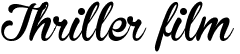
This is due to the font being quite flowery, girly and of a 'pretty' nature. This would not fit our concept of a frightening thriller as the font would connote something else rather than this. We also have taken into account the connotation of colours such as, Black connoting dark, fear of the unknown and Red connoting things such as danger and fear. By using the correct colours we present the right message to our audience of what kind of themes will be in our thriller film. For example if we decided to use yellow credits we may be giving the wrong idea to the audience and may not be meeeting their expectations. Also within our opening credits we have placed in effects in order to create smooth transitions from credit to credit. For example: we use a blur for the title which, then gradually fades away to connote that our main character gradually fades away and leaves the thriller film. By doing this once again our audience is made aware of our thriller plot and we are achieving the requirements they want by, presenting the credits in an interesting way.

To conclude we are happy with our choices and feel like we have taken a lot of great care and detail into the choosing of them due to, the research, discussions and group meetings we have had regarding them. We feel our thriller opening credits will fit in with the conventions of a thriller film and will impact on our target viewers efficently.

Our Thriller Film:
Actors- Tiernee Long, Isla Hearn
Director- Sophie Elliott
Title- The Contiuity
Music- Emma McComish
Costumes- Charley Kay
Editing- Sophie Elliott + Charley Kay
Production- Guneet Bathla
Writing- Erika Gardiner
Co producer- Holly McComish


Thursday, 21 November 2013

Sound Planning- Miss Miller


In thriller films sound is used to create tension and suspense within the audience and to make them feel scared and frightened. Music is also used to build a climax when, a particular event is taking place as well as to create the mood of the scene in the film. A series of sounds and sounds devices can be used in order to be placed within the thriller and no thriller is without it. In class we watched a thriller muted with no sound and a thriller not muted (with sound) and we came to the conclusion that without music the thriller is no where near as impactable nor scary. This means that sound in our thriller will be esential which, is why planning and intense discussion has taken place regarding this.

One sound we as a group have decided to use is parallel sound of conventional train sounds. This includes sounds of the tracks, pedestrians passing, the wind as the train approaches, opening and closing of doors and the voice announcements. We will use these sounds to create a sense of normality which, will allow the audience to be able to relate to the characters as they would be familiar with the sounds present. This is conventional to the thriller genre as it alows the audience to create a greater relationship with the characters which then results in a bigger care of what happens to them. In terms of cresting suspense it will help as it will Alow us to make things appear as normal so that when things get bad, there is an evident and clear contrast for the audience to relay to.

We are including the sound feature of diagetic speaking in our clip also. This is between the two female victims (the main and the bystander) talking and exchanging everyday normal conversation.
This will help the audience as they will be able to see the girls personalities and their vulnerability contrasting of the act about to be played out on them. This is conventional to the thriller genre as the victim is normally vulnerable and their vulnerability is shown to the audience through there way of speech. This alows the audience to sympathise which, then creates suspense as they fear for what will happen to her in the future of the thriller.

Another sound device we will be using is non diegetic sound. This will be a soundtrack that has a gradual pase build and is considered 'creepy'. This will add suspense and enigma to the film as the pase will give the film an atmosphere and a sense of uneasiness. This is conventional to the thriller genre as a soundtrack enables whatever happens to be more unexpected as the music is used as a tool to bring whatever is happening to life. We see example of this used in our inspiration such as, scream.
 A non diagetic noise will also be placed in our thriller to emphasise and highlight when the victim first sees the killer and then this is repeated after  when she witnesses him again later in the clip. The use of this alows the audience to have a sense of dramatic irony as they will know the killer is approaching before the victim will. This will create suspense and enigma and is conventional to the thriller genre as unexpected loud noises are used to jolt and shock the audience.

It is important wihthin a thriller for the audience to build a realtionship with characters/relate to the scene through the use of sound. This is because, we can use sound to entice and draw in our audience but, also as a vehicle to drive their emotions forward. For example: The use of a slow, low soundtrack can make the audience be in suspense and enquire as to what is next going to happen, where as, a high pitched scream can make the audience feel shocked, surpised and/or frightened. This shows us that the use of sound can create an impact on our audience when used in the correct/right places within our sequence.

To summarise my post, the use of these specific sounds will help me to produce a good sequence due, to how conventional they are to the genre, I.e: Sudden unexpected sounds. By making our thriller sequence as conventional as possible we will be reaching out more to our target audiences and therefore, obtaining a more sucessful thriller. Overall, the use of sound will impact our thriller greatly and will make our scenes more enjoyable, intresting and most importantly frightening to view.

Thursday, 14 November 2013

Planning editing styles- Miss Georgiou

Editing styles are important within a thriller as it alows the scenes to flow fully and to be connected in ways that entice and draw in the audience. A particular style can change the transition of a scene and thus have a huge impact so, as a group our planning process for this had to be discussed fully.

The first editing style we have decided to use is timing of shots. This will be used throughout our clip but as a group we highlighted it as to be used mostly at the beginning of the clip and at the end. This is so the audience can view the contrast of when the character is safe (at the beginning) and when the character is in danger (towards the end). This is conventional to a thriller genre as it creates a pase for the film. This pase can mirror how we want/expect our audiences heart rate to be at the beginning; slow and at the end fast passed due to the suspense and excitement. This means that the shots will be slower at the beginning and faster at the end to allow the audience to compare and contrast and therefore make the ending more effective.

The second editing style we have decided to use is a reaction shot. This was inspired to us by other films such as scream, Halloween etc as it allows the audience to see exactly how the characters are feeling. By allowing the audience to see this we create a relationship between audience and character meaning whatever then happens to the character is more important to that audience as they have developed care and sympathy towards them. The reaction shot will be used to show both the focal victims reaction to the killer and the by standing victims reaction to the killer. This alows the audience to see both reactions and to be able to compare and contrast these to create their own picture of how the characters are feeling. This alows the audience a front row view of exactly what emotions and what feelings the characters are undergoing which means as a group we have more chance of having our audience undergo these feelings too alongside them.

The third editing style we have decided to use are jump cuts. This is one of the first editing styles we concluded as a group we would use as it makes the character think about what's going to happen next which creates an interest in the film. A jump cut draws the audience attention to a particular focal point which in our case will be  when the main character is in danger and then it will jump to the main character waking up as if she is safe. This jump will create suspense and shock as the audience will not expect it to happen. The fast pase will increase the  time this happens making it all very quick and free flowing. By using this it is conventional to the thriller genre as the purpose is to thrill and excite which by using a jump cut we can accomplish.

To conclude a selection of editing styles will allow our thriller to flow freely and to obtain a sense of ease. It will appear as if it is all connected so that the it is viewed as a sequence and not a series of shots. Particular shots will allow us to create relationships with the audience which means we have a more effective and more impactable clip.  Therefore, by using the editing styles we have chosen above we will be able to a achieve this and thus a better thriller opening.